What You Actually Own When You Buy an OTP
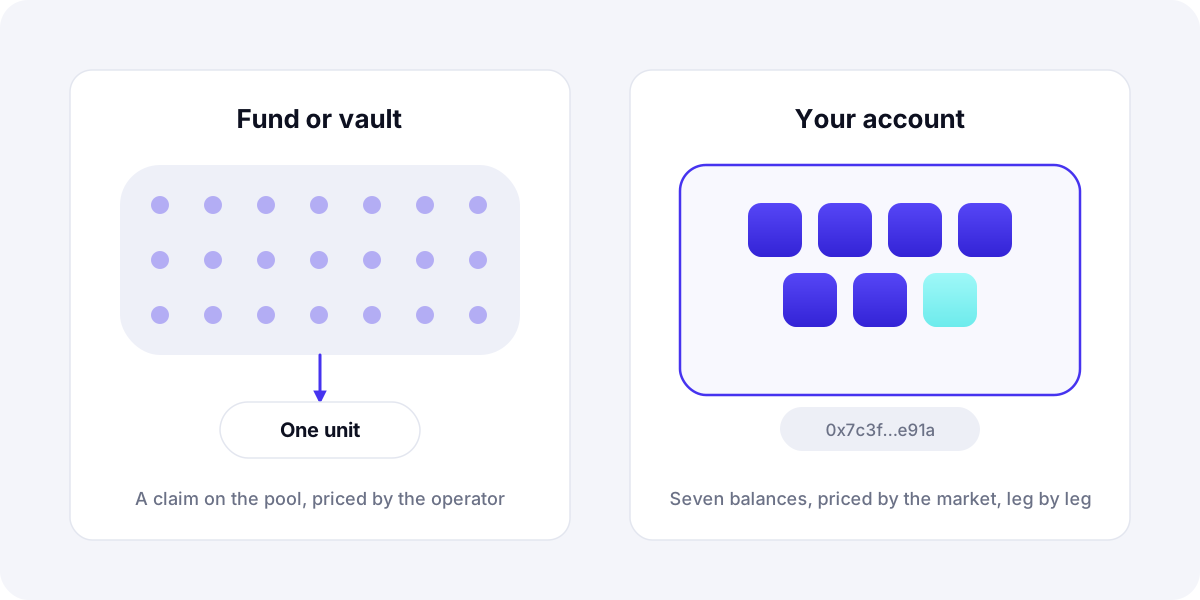
A fund answers the question of what you own with a unit price. An OTP answers it with the token balances in your own account.
A fund answers the question of what you own with a unit price. An OTP answers it with the token balances in your own account. The two answers describe different structures, and most of what follows about ownership, exits and risk comes from that difference.
Why a fund has to give you a unit price
A pooled product, whether a registered fund or an onchain vault, takes capital from many participants into one container and issues units against it. The unit is the participant's claim. To know what that claim is worth, the operator computes a net asset value, which is the verified assets held by the container, less liabilities, less accrued fees, divided by the units outstanding. Every figure the participant sees flows through that calculation. A deposit is priced at it, a redemption is paid at it, and performance is the change in it over time.
The unit price is doing real work. It lets many holders share one set of positions without any of them holding a position directly. It lets a curator run one strategy at scale. It is also why a well-run vault publishes who signs the NAV, how fresh a signed value has to be before it can be used, and how far a new value may move from the last before the system stops and asks questions. Those controls exist because, in a pooled structure, the price is the product.
What lands in your account when you buy an OTP
An Onchain Token Portfolio holds no pool. When a participant buys an Index OTP, a single transaction converts their stablecoins into the constituent tokens at the weights the methodology publishes, and those tokens land in an onchain account the participant owns. Seven names at one seventh each means seven balances, each visible on a block explorer, each with the participant's address on it.
There is no unit because there is nothing to hold a unit of. The position is the balances. Its value is the sum of each constituent's market price times the quantity held, which anyone can compute from public data without asking City Protocol for a figure.
The protocol takes no custody, holds no private key and has no authority to withdraw. Today it holds no permission to trade inside the account at all. In the next phase, a scoped and revocable permission will let a Rebalancing Executor apply each published change to the constituent list inside the account, limited to the constituent contracts and an execution router, and the participant will be able to remove it at any time.
How your basket is tracked without a price tag
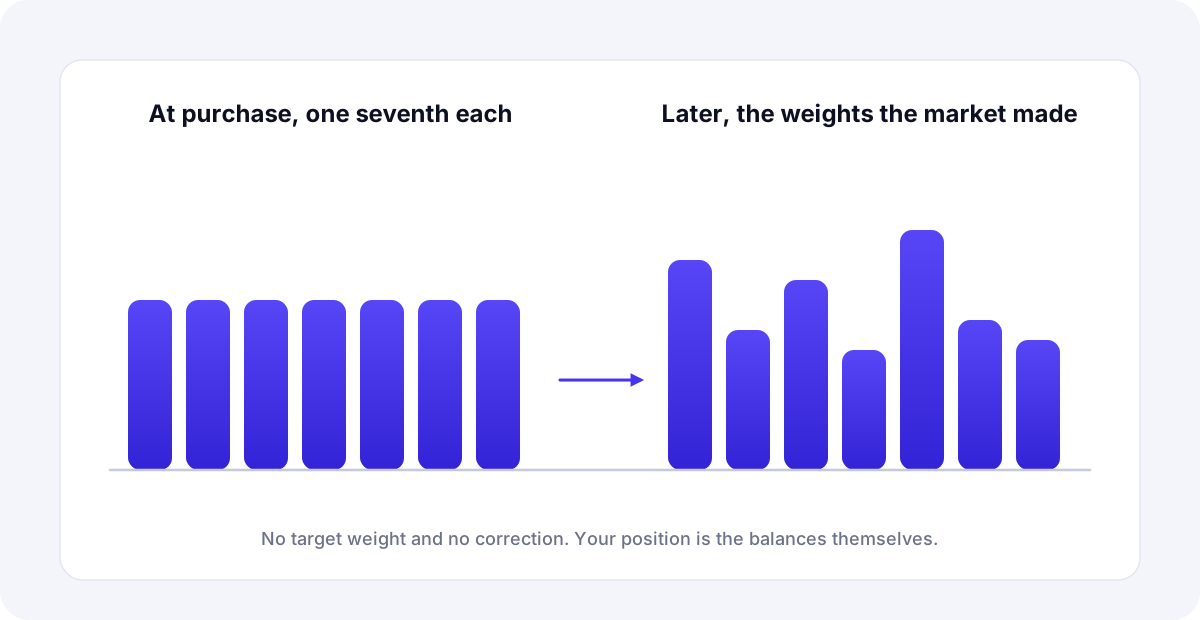
An OTP is operated against two numbers per constituent. The weight at purchase is set by the methodology, and for an equal-weight index it is one divided by the number of names. The actual weight is the market value of that constituent in the account divided by the market value of every constituent in the account.
After purchase there is no target weight. Prices move every hour, so actual weights move every hour, and the basket is left to move with them. Nothing is sold because a name has grown and nothing is bought because a name has lagged. The only thing that changes a basket is public information the methodology names: a new filing or a disclosed trade for a Guru OTP, a change to the constituent rule for an Index OTP. Each change is published before it executes and recorded on the product page against the information that caused it.
None of that requires a unit price. The participant's account is priced by the market, leg by leg, and the operator's only job is publishing the list and its changes.
What you take on when you hold the assets yourself
Holding the assets yourself means holding the responsibility that comes with the account. There is no operator to call about a lost key.
After purchase the basket carries whatever weights the market has made since. A participant who checks the account on a Wednesday will see the weights the market made, and that is by design: there is no target to return to.
An OTP removes pool risk and leaves execution risk in place. There is no shared contract holding participant funds that can be drained. Constituent prices can fall, and a trade can fill badly if a venue is thin at the moment it runs. In the next phase, a Basket Execution Router will bind every trade to a price guard and a per-leg slippage cap and halt rather than fill when either is breached.
Why we don't use vault words for an OTP
Unit, NAV, redemption and epoch are vault words. They describe a pooled structure correctly. Applied to an OTP they describe something that does not exist. City Protocol runs both architectures on one issuance and operation layer, and the vault side keeps every one of those terms, because on that side there is a pool and the terms are load-bearing. On the OTP side the equivalents are account, balance and weight.
The unit price told you what your share of the pool was worth. The account tells you what you own.
Architecture as published in the City Protocol issuance and operation layer documentation as of September 2026. This post is for educational purposes only and does not constitute financial or legal advice or a solicitation to buy or sell any asset. Eligibility checks, KYC and jurisdiction limits apply.